

How to Mix Wood Tones in Whole-Home Furniture
How to Mix Wood Tones in Whole-Home Furniture
In order to achieve harmonious combinations without chaos, you need to choose one wood tone to be a dominant one. Remember to look for undertones, not only the colors. In addition, make sure to use every secondary wood color at least twice and vary the grain patterns. It is preferable to use two or three major finishes for the open spaces of your home. Rugs, stones, fabrics and accents such as black or bronze will provide a visual boundary between the timbers.
Why Matching Every Wood Is Usually the Wrong Goal
If all furniture items come from a single matching set, the room will seem boring. The reason is that all surfaces are identical when it comes to color, grain and finish. Houses are usually built through years, and although the floor can last for decades, the dining table or bedroom suite will be acquired at other times. Intentional mismatching is more natural and allows your favorite items to express themselves.
Start With the Fixed Wood Surfaces
Prior to selecting the furniture, pay attention to the wood already installed in the building. They include such items as floor, stairs, wall paneling, doors and kitchen cabinets. They occupy much more space than just one side table. That is why they form the starting point for you. If you have honey oak floors in the open plan home, those floors are the basic wood of yours despite the fact that it may not be your favorite one.
Choose a Dominant Wood Tone for the Whole Home
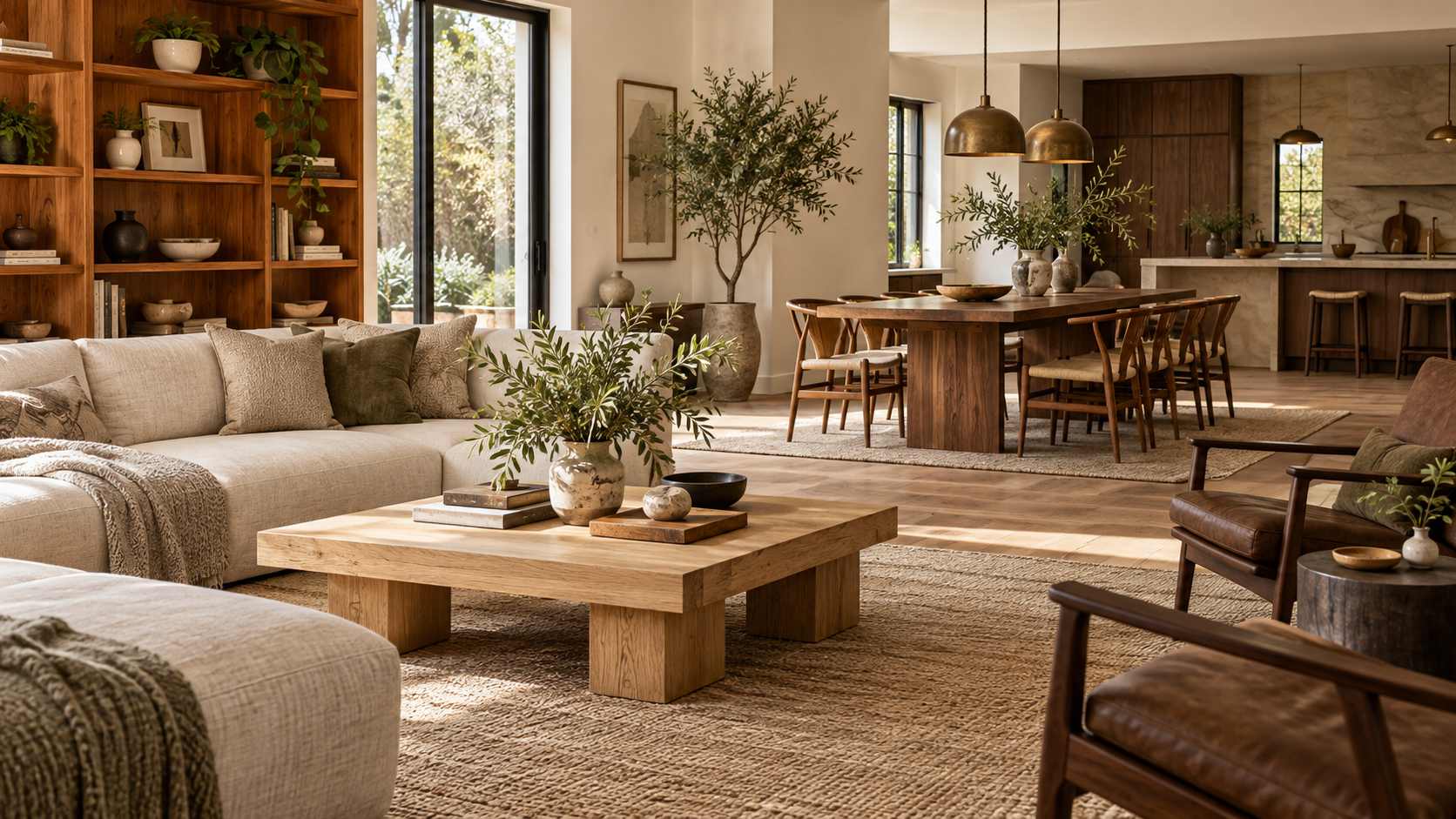
The dominant wood should comprise half to two-thirds of all visible woods of the main living spaces. It can be the floor itself or a huge bookcase. The other woods will serve only as the accent ones. You do not have to make any calculations. However, the visual hierarchy should be obvious immediately after entering the room.
ALT: Dominant light oak with walnut accent furniture across an open-plan interior
Read Undertones Before Comparing Light and Dark
The selection of wood is not merely a matter of selecting light or dark shades. All wood carries an inherent “cast” of either a warm, cool, red, or even a gray nature. There may be occasions when two medium-brown types of wood do not go well together because their underlying tints oppose each other. For this purpose, place the samples of wood on a plain sheet of white paper.
Use this chart as a guideline and not as an absolute reference. The name of the wood species will not necessarily be the final color due to stains, oils, or aging effects. A physical sample from the factory is always the best guide over a picture or a description.
Mix Grain Patterns as Carefully as Color
The grain gives the wood its “movement.” Rift sawn oak is characterized by vertical lines, whereas crown sawn veneers have broader arched grains. Burl is highly figured wood. If your floors already have many knots and complex patterns, it would be good to choose furniture that has a simpler and straighter grain to avoid visual overload.
How to Mix Wood Tones Room by Room
Mix Wood Tones in Bedroom Furniture
While your whole house needs a consistent feel, every room serves a different purpose. Using the same wood types can link different areas. At the same time, you can change other materials to handle light or daily wear. Here is how to manage the mix in specific rooms.
Sala de estar
Begin by examining the largest piece of wood that appears once you enter the room. If your flooring is oak, walnut will create enough contrast to be purposeful. An oak coffee table may still work for you, but it should rest on top of a rug in order to create space between the two oak surfaces. If your sofa features wooden legs, attempt to coordinate them with your secondary wood selection or just opt for black.
At least one surface material other than wood should be featured next to your seating area. Glass, stone, and lacquer tables can serve this purpose, adding contrast to your palette. This will ensure that your wood selections will really pop. You have access to the entire furniture collection to find items that fit your taste and don’t have to match perfectly.
Sala de comedor
The dining table is a huge focal point because of its large flat surface. It is a great place for your accent wood. Your chairs can then match the main floor color or use fabric seats to make the transition smoother. Never put a large table on a floor that is almost the same color. Instead, use a rug or pick a table that is clearly darker or lighter to create a sharp, clean look.
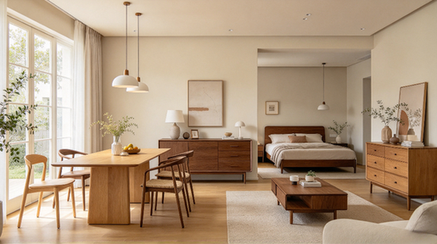
For instance, a 220-centimeter walnut table looks great with oak chairs if oak is used elsewhere in the house. The chairs provide small bursts of color, while the walnut table acts as the solid anchor for the room. This prevents a third wood type from making the space feel messy.
Habitación
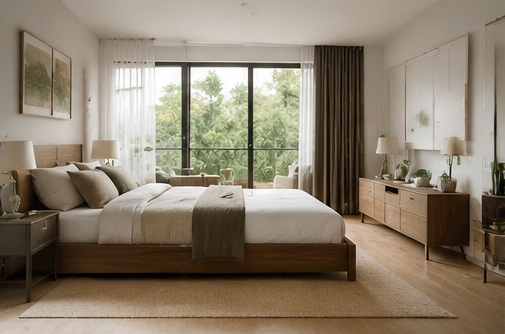
It is ideal to have a more neutral and simplified design scheme in the bedroom. The bed or the wardrobe would be used as your primary wood choice and then the other wood for small furniture such as the nightstands. In case you have a big built-in wardrobe, there is no need to make the bed look similar to it.
A great way to prevent having too many wooden pieces clashing in the bedroom is by using an upholstered bed. You can check the gallery of a residential project to find out how the same wood looks in different rooms.
Use Bridge Materials to Connect Different Woods
“Bridge” material is something that fits in between two woods. Creamy wool, for instance, can go well between light oak and dark walnut. Gray stone will be a great option to place between smoked oak and natural wood. Beige and gray rugs will unite three wood finishes without needing to match them precisely.
The metal is also a perfect material for uniting woods. The matte black is an excellent option as it will frame the wood but will not warm the room. Honey oak and walnut go well with bronze metal. In order to get a professional look of your interior, use the same metal for lamps, hardware and legs of furniture.
Control Finish and Sheen
Even if the colors match, furniture can look odd if the “shine” is different. A shiny, lacquered cabinet reflects a lot of light. In contrast, a table with a natural oil finish looks soft and matte. For a comfortable home, it is usually best to keep most of your wood pieces in the matte-to-satin range. This makes the different pieces blend more naturally.
Common Wood-Mixing Mistakes
Most rooms that look “off” don’t have too many types of wood. Instead, they have too many random pieces that don’t talk to each other. Stand in the doorway and look for any wood finish that only appears once. If it doesn’t have a partner, it might be a mistake. Watch out for these four errors:
· Trying to match a new piece to your floor using only a phone photo instead of a real sample.
· Picking three brown woods that are the same darkness but have clashing red and gray undertones.
· Using very busy grain patterns on the floor, walls, and tables all at once.
· Adding more wood items to “fix” the look when you actually need a rug or a painted surface to give the eyes a rest.
If the room still feels wrong, try taking out the smallest wood item. Often, one stray stool is the piece that is ruining the pattern. Reading furniture design articles can help you figure out if your problem is the wood color or just the way the room is laid out.
A Simple Sample Test Before Ordering
Mix Wood Tones in Whole-Home Furniture
Before you buy, put your wood, fabric, stone, and metal samples together on a large board. Small chips are hard to judge. Move this board around the room at different times of the day. Check it in bright sunlight and under your lamps at night. If the woods only look good at noon, the combination is likely too risky.
When ordering custom furniture, always ask for a control sample. This should show the wood type, the stain, and the shine level. Since wood is a natural material, it will never be 100% perfect. Having a physical sample helps both you and the supplier agree on what the final piece should look like.
About Juhaus
Juhaus, formerly known as VN CASA, provides high-quality furniture for homes and hotels. They help with everything from single furniture pieces to full room sets and material choices. This expertise is very helpful when you need to connect different rooms like the living and dining areas. You can learn more about what they do on the Juhaus company page.
Conclusión
In order to have a wonderful wood palette, hierarchy is very important. Begin with your permanent surfaces and have one dominant wood color. Be sure to examine the undertones in your actual lighting and use your accent woods deliberately. Employing various grain scales as well as the use of non-woods such as rugs or metal helps you avoid surface competition.
Using no more than two or three dominant woods is always the better choice. Using a fourth wood in your bedroom that does not match your whole home can be done, but in most cases, this is the exception rather than the rule. Your end result is always the same: every wood must serve its purpose.
Preguntas frecuentes
How many wood tones should there be in one room?
There should usually be no more than two or three wood tones per room. Choose one as the dominant tone, the second as the secondary and the third one to use as accents on some objects. You may also have more if you go for an eclectic look, but you’ll have to be really careful about choosing the wood grains.
Do wood furniture and wood floors have to match?
They don’t. Furniture always looks better if it contrasts with the floor. All you need to do is to use a rug that will create a border and add some elements of the same color of furniture elsewhere in the room.
Is it okay to combine warm and cool wood tones?
Sure, it is. However, you should choose one light wood and one dark one in order to balance out. A neutral connecting material will be a good choice, say, gray stone.
Should there be the same wood furniture in all rooms?
It is not necessary. It will be better if you keep one wood tone the same throughout your house, while others can be different in different


